
Who is in charge? The city council? The state government? The federal government? That is a question that a lot of people have been asking of each other in search for leadership amidst the pandemic of COVID-19. Truth, expertise and clarity – these crucial elements of crisis leadership seems to be missing from most of the global political landscape.
Some political leaders have elevated public health experts to the tenuous task of public communication while others have taken the occasion to gain more limelight. Some have tried to balance public health communication and political strategy. This lends to an important question: Is the COVID-19 response a failure of communication?
What does WHO say about communication?
In outbreaks and epidemics, successful communication of risk and the mitigating actions that can be taken is often the most crucial element of effective outbreak management
World Health Organization, Outbreak Communication Planning Guide (2008)
In the context of pandemics, WHO emphasizes proactive communication of public health information to the public as an essential tool at every level of the response strategy. In the figure below, the blue arrow suggests the time at which proactive communication plays a crucial role in the rapid public health response – to help limit the spread of a disease
and save lives.

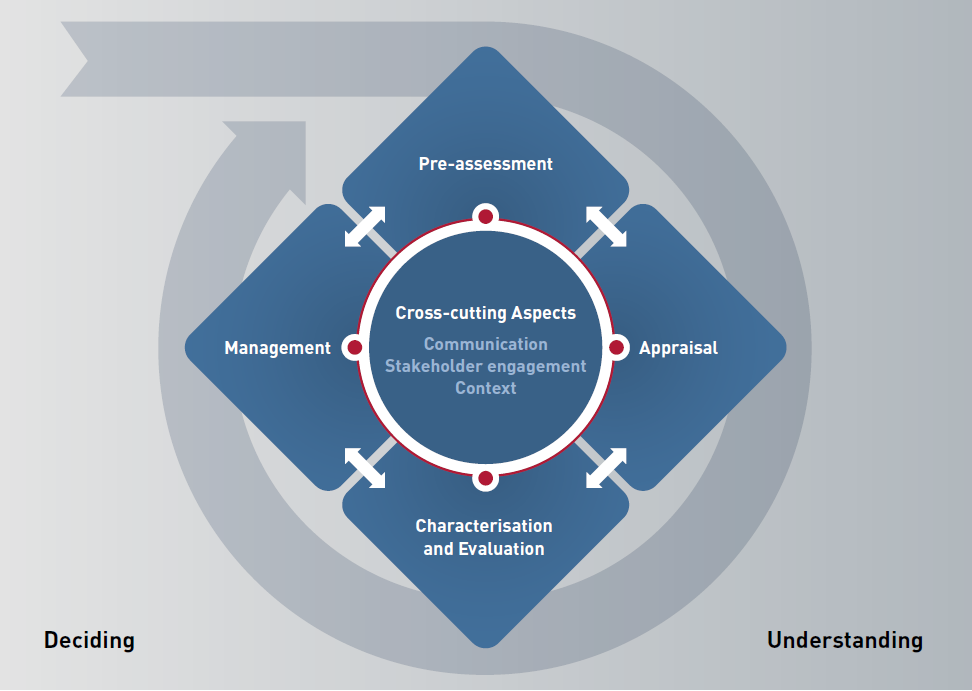
The International Risk Governance Council, an independent non-profit, puts communication at the center of its recommended risk governance strategy. Specifically, ‘risk communication’ may be defined at the exchange of information, directly or indirectly, between experts, policymakers and public.
The 2002-03 SARS outbreak lead to WHO release guidelines for communication in case of outbreak. It was based on the following principles:

Communication in the COVID-19 Reponse:
Whether or not the citizens trust their leaders has become crisis in the response to the crisis. Elected leaders in United States, India, Brazil and Britain initially downplayed the dangers of the epidemic. However, the leaders in South Korea and Germany have fared relatively better in communicating public health information to the public. At the global level, the credibility of WHO has taken a hit due to it being seen as favoring China.
At the same time, most countries did not announce early the dangers that their citizens faced as the outbreak spread from one place to another. Moreover, they were also not transparent regarding their preparedness and resource constraint faced by the healthcare system if there was a sudden flurry of infections. Whether to avoid injuring the economy or to protect their political interests, critical communication was lost.
Moreover, the fears of the public, pertaining to health, economy and daily life, have remain unaddressed by most leaders. Even when public health experts have been heeded to, concerns about daily life have been ignored from public health communication leaving people in confusion about their lives (except in the case of New Zealand). To make the situation worse, these seems to be a lack of coherent planning about communication with different levels of government suggesting different things at the same time.
While China has been seen as a case of authoritarian dysfunction, democratic governments around the world have performed no better in terms of these principles. This is further reflected in how this failure of communication affects the public and policy implementation on a regular basis.

Starting with poor reporting of cases, lack of good and clear public health communication initially led to confusion about symptoms of coronavirus. This meant that people were receiving all sorts of misinformation about how to find out, what to do, who to visit in case they suspected themselves or someone they know to have contracted the virus etc. At the same time, lack of clear scientific guidelines has meant that the surveillance of the outbreak has been poor and irregular within and between countries.
Lack of clear and specific inter-governmental communication has also meant that different levels of government have initiated responses at different scales with unfocused utilization of resources. The emblematic example of this is the buying protective equipment and tests for medical professionals. Hospitals, states and federal governments have often found themselves in conflict situations bidding each other out of auctions.
At the same time, adoption of protective behavior has been non-uniform across and within countries or even states. Some of this can be attributed to lack of clear public communication about the utility and effectiveness of masks, sanitizers and physical distancing, which could have better nudged the citizens in adopting good public health practices.
Conclusion:
Prolonged incidence of risk and uncertainty along with changing information landscape has meant that communication is particularly difficult in this pandemic. However, the communication tools available to the governments and agencies are more potent to reach specific populations than they have ever been. It seems that they have performed poorly in this aspect of governance.

 Changing Economy and Politics