
To put it bluntly, there may have been a time (perhaps at the end of the Cold War) when 12 per cent of the world’s population could afford to impose demands on China (20 per cent of the world’s population), anger the Islamic world (20 per cent of the world’s population), ignore the demographic explosion in Africa (15 per cent of the world’s population) and humiliate Russia (the world’s second largest nuclear power). That time has gone.
Has the West lost it? by Kishore Mahbubai
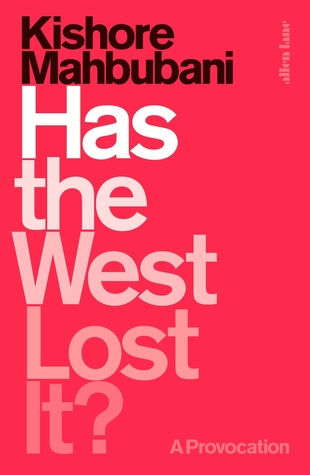
In a world consumed by the West’s meltdown, signified by the election of Trump, Brexit, the successful rise of anti-EU parties, breakdown of the ‘Washington consensus’ and shattering legitimacy of multi-national bodies, the Western publications have spilled a lot of ink and dedicated screen-space to analysis of what has gone wrong. However, much of this inspection has only reinforced their sense of exceptionalism and supremacy, in that, this is just a passing phase and the West will find itself soon in a Wonderland.
Away from this hotchpotch, Kishore Mahbabuni looks at the recent Western actions from an Asian perspective in his book “Has the West Lost it? A Provocation” and spills much less ink in the process (just 60 pages!). He analyses the shifting geopolitics and economics that has caught the West blindsided in it’s hubris and interventionism, and casts the Western response to major non-Western events in a new light, one that questions the predominant narrative of Western exceptionalism and highlights the strategic errors in those reactions.
The predominant narrative that posits the fall of Soviet Union and victorious end of the Cold War by the West misses, according to Mahbubani, or atleast underestimates the other more important developments of the rising Asian countries at the time. In the West’s imagination, it was a triumphalist moment that reinforced their power and hegemony in the world. Temporarily it may have been the case. But the belief in this hegemony was permanent. This was memorialized by Francis Fukuyama in his essay “The End of History”. The West further humiliated the already humiliated Russia by expanding NATO, providing a strong political ground for Putin’s aggression in Ukraine.
Furthermore, Mahbubani observes that most powerful West policymakers saw the protests and ensuing repression at the Tienanmen Square in China, feeling good about their democratic political system and capitalist economic system. It shielded the historically important process of the opening of Chinese Economy from Western narrative. On the political changes in China, he describes the new freedoms afforded to the Chinese people compared to forty years ago and asks “would 100 million Chinese tourists return home freely if they were indeed oppressed?”
Similarly, the balance of payments crisis of 1990s in India and later, the Asian Financial Crisis saw the West feeling a sense of financial supremacy over the rest. They felt that they solely had the magic formula of ‘economic growth and political stability’. However, these supposedly struggling economies managed to become the growth engines much to the envy of the West proving the belief wrong that democracy is a necessary condition for economic success. While these major events took place and were narrated complacently in the Western public spaces, Mahbubani narrates three revolutions that took place in the rest of the World that were left unnoticed.
First, he states a political revolution both in democratic and non-democratic societies such that leaders everywhere realized that they “have to demonstrate daily that they are improving their people’s lives”. Another was a psychological revolution with the hope and belief in a better future. “All the things that Western populations took for granted and the Rest thought were out of their grasp are becoming universal.” The third was the revolution in governance in form of better public policies. The west, says Mahbubani, had an influential role to play in these revolutions by providing the rational thinking, sharing its ideas and technologies with the rest. However, his narrative focus limits him from elaborating on the terms on which this has happened.
The book states that strategic errors of the West reached their peak with its reaction to 9/11 and ensuing war frenzy that shielded the important event of China’s entry into the WTO – an introduction of new workers from China into the globalized labor market led to “declining real wages and a smaller share of labor in national output”, especially for the West. While the war hysteria has waned considerably, the interventionism and bombing campaigns remain just as rampant. This, Mahbubani, finds problematic.
Bush’s call to planting ‘seeds of democracy’ in the Middle East is seen as hypocritical by most Muslims. It is a “cynical promotion of democracy in adversarial countries like Iraq and Syria and not in friendly countries like Saudi Arabia.” Often, the West walks away and takes on no moral responsibility for the adverse consequences when intervention turns sour.
On global trends of progress and Western military intervention, he comments:
the two regions that seem to be an exception to this broad trend are the two regions that the West has meddled in the most in recent times: North Africa and the Middle East. Is the relative failure of these two regions a result of bad luck? Poor leadership? Flawed societies and cultures? Or Western meddling?
Has the West lost it? by Kishore Mahbubai
In its supposedly benign interventionism, the West has often assumed that “the modernization and economic development of any society will lead to less religiosity and more secularism” This underestimates the influence of Islam, writes Mahbubani. In fact, “economic development and education are leading to greater religiosity” in Islamic countries. He suggests that the West withdraw completely from the middle east just like it did from Vietnam and let the region progress on its own terms, much like ASEAN countries progressed in time, despite American withdrawal and pessimism.
Mahbubani observes that the Western leaders did nothing to explain to their citizens the consequences of these fundamental changes. Their newspapers and commentators were convinced they were right, either pretending any of the major developments in the rest of the world was not happening or they were more than pleased to dismiss them. They totally missed the monumental shift of power away from the West. While the west shared its wisdom with the rest, it has been very unwilling to take any wisdom.
Mahbubani asks the West to reach a new consensus on its the new global economy in light of the fact that, “from the financial crisis (2008–9) to the Ebola outbreak (2014–16), from the Climate Change Summit in Paris (2015) to the terrorist attacks in leading capitals (2017), we learn that all cabins on the global boat must work together.” In this endeavor, he argues for serious introspection in the West away from the prevalant self-deception, hubris and condescension. The West needs to accept the new reality of its diluted power and changed mind-sets of non-Western populations. Its policy of “maximum insularity and self congratulation” in the latter part of 20th century and disastrous wars and incessant bombings in the beginning of the 21st century have been catastrophic for the world and for itself. The marginalization of United Nations in favor of unilateral actions and for suppression of voices by the West reflects as much of its arrogance as its waning respect in the eyes of the world.
Finally, since American and European interests have diverged, Mahbubani recommends that they focus their individual strategies on their primary enemies – for Europe, it is spillover of threats from Islamic world and for America, it is China. “Americans have taken advantage of Eurpoe’s strategic passivity” and destabilized Europe’s geographical neighborhood. According to him, no Russian tanks threaten Europe unless America meddles in Ukraine, the consequences of which Europe cannot walk away from.
He recommends that Europe work with China to build up North Africa and try to import the East Asian economic success stories into North Africa – a policy which may be in its strategic interest. He also bravely proclaims that America should make peace with the Islamic world as it is not America’s primary strategic challenge.
Iran will never be a threat to America.
Has the West lost it? by Kishore Mahbubai
If America does not course correct, Mahbubani foresees it making the same mistakes that the Soviet Union made while dealing with America, i.e. confusing an economic competitor with a military competitor. For him, “the biggest mistake that America could make is to step up its military deployments in East Asia to balance a resurgent China.” He advocates for a strategic alignment of interests between China and America on the Korean peninsula with a strong commitment that a reunified Korean peninsula be a neutral country.
Throughout the book, Mahbubani makes a compelling case for Western policymakers to rethink the foundation of their foreign policy. While his historical interpretation of events, cast in a new light, is nuanced and provocative, his recommendations seem overly optimistic and unrealistic in a world wanting in the slightest of cooperation among powerful countries on strategic issues. Moreover, some of the suggestions seem to miss the twists and turns of that define any historical process.
For example, while unified and fiercely independent Korea might ultimately a Western dream, coming even for Mahbubani, especially given China’s desire to control Hong Kong in a more centralized manner, Chinese expansion of naval infrastructure in Indian Ocean, East Asia and Africa suggests a divergence rather than an alignment. Whether the Chinese would appreciate a fiercely independent country on their doorstep is anybody’s guess. The more immediate question would be what that independence would entail for the rest of Asia. It misses the immediate neighboring ‘influence’ of China that a unified Korea will inevitably face.
As the Western share of the global population and of global power recedes, the West should calculate that it is in its best interests to have a stronger rules based order. One way to do this is to strengthen, not weaken, the UNSC. The best way to strengthen the credibility of the UNSC is for the UK to give up its seat to India and, as I argued in The Great Convergence, for France to share its seat with the EU.
Has the West lost it? by Kishore Mahbubai
Mahbubani sees the last few hundred years of Western dominance as an aberration which will come to its ‘natural end’. He claims that “modernization is poised to enter Arab, Turkish and Persian societies” just like it enters Asian societies, that the Nordic model of society will gradually become universalized, that the “Middle East region with less Western meddling will ultimately be a predominantly peaceful region” etc. This invocation of a natural order of things that might follow, sounds just as self-aggrandizing as Western exceptionalism.
The failings of democratic political system are dominating Western societies at a point where they need their leaders to make important changes in foreign and national security policies. These challenges will test the longevity of democratic setups all over the world, especially in the context of global challenges managed via national governments. Whether the response is strategically coordinated or not will decide the future of human civilization. The way West responds to this dilution of its power will ultimately cast the mold for the next superpower to fit in.
The best outcome would be a number one power (namely, China) that respects ‘rules and partnerships and habits of behavior’ that America could live with.
Has the West lost it? by Kishore Mahbubai
What will the ‘Beijing Consensus’, if there ever is one? Will China be a benign hegemon? What role will India play?
If history is any guide, the very idea of a sole superpower means rules become perfunctory. Yes, the West has lost it. But the Rest cannot afford schadenfreude. For the ‘new Rest’, China may prove to be just as costly.
 Changing Economy and Politics